Minimum Energy Efficiency Standards (MEES) is one of those regulations that often becomes urgent at the worst possible moment: just before a lease renewal, sale, refinance or tenant negotiation. For many commercial landlords, the latest government update has raised a simple yet important question: What should we do now?
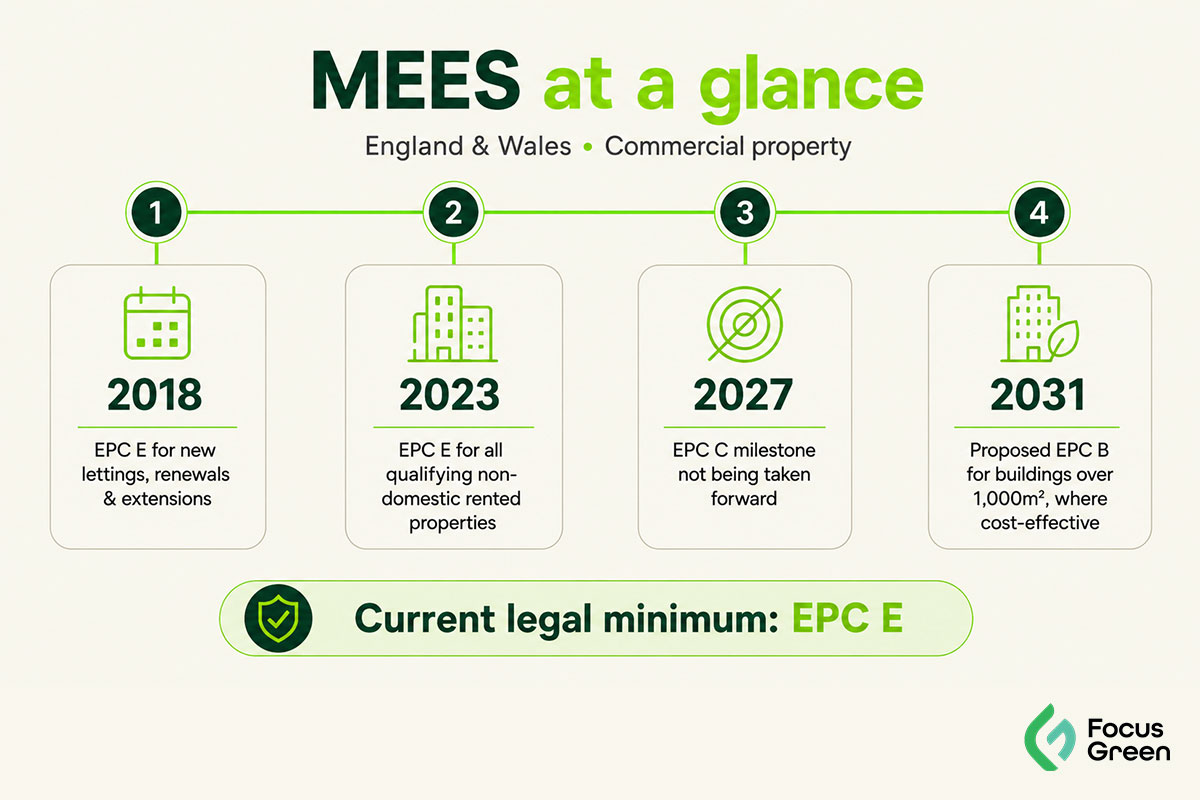
The answer is not to panic, but it is also not to wait. The government has confirmed its intention to move larger non-domestic privately rented buildings towards EPC B from 2031, where cost-effective. At the same time, the current legal minimum for qualifying non-domestic rented property in England and Wales remains EPC E, unless a valid exemption is registered.
At Focus Green, our advice is straightforward: use the time available to properly understand your position. A landlord who reviews EPC ratings, lease events, floor areas, and improvement options early will usually have more control over cost, timing, and disruption than one who waits until a deadline or a transaction forces the issue.
For commercial landlords, the key points are:
- EPC E remains the current legal minimum for qualifying non-domestic rented properties.
- EPC C in 2027 is no longer being taken forward.
- EPC B from 2031 is proposed for non-domestic privately rented buildings over 1,000m² in England and Wales, where it is cost-effective.
- The EPC B change still requires secondary legislation, but the direction of travel is clear.
- Waiting for every final detail is not a sensible commercial strategy.
What is MEES?
MEES stands for Minimum Energy Efficiency Standards. In simple terms, it is the regulatory framework that sets the minimum EPC rating required for privately rented property in England and Wales. For non-domestic rented property, the current minimum level is EPC E, subject to the property being within scope and no valid exemption applying.
It helps to separate two ideas. An EPC, or Energy Performance Certificate, is the certificate that rates a building from A to G, with A being the most efficient. MEES is the legal standard that uses the EPC rating to decide whether certain rented properties can lawfully be let.
For commercial landlords, MEES is not just a technical energy issue. It affects whether a property can be let, whether an exemption may be needed, and how energy improvement works should be planned alongside lease events, refurbishment, tenant fit-out and capital expenditure.
Background and regulatory context
The non-domestic MEES rules are set out in the Energy Efficiency (Private Rented Property) (England and Wales) Regulations 2015. They were introduced to tackle the poorest-performing rented buildings, originally focusing on properties rated EPC F or G. GOV.UK guidance describes these as “sub-standard” properties in the non-domestic private rented sector.
Government guidance states that heating and powering non-domestic buildings account for around 12% of UK emissions, and that around 60% of today’s non-domestic buildings are expected to remain in use in 2050. That means improving existing stock is a major part of reducing energy demand.
For landlords, the practical impact is more immediate. Poor energy performance can lead to higher running costs, reduced occupier confidence and additional compliance risk. MEES turns energy efficiency from a “nice to have” into a property management and asset planning issue.
What has changed now?
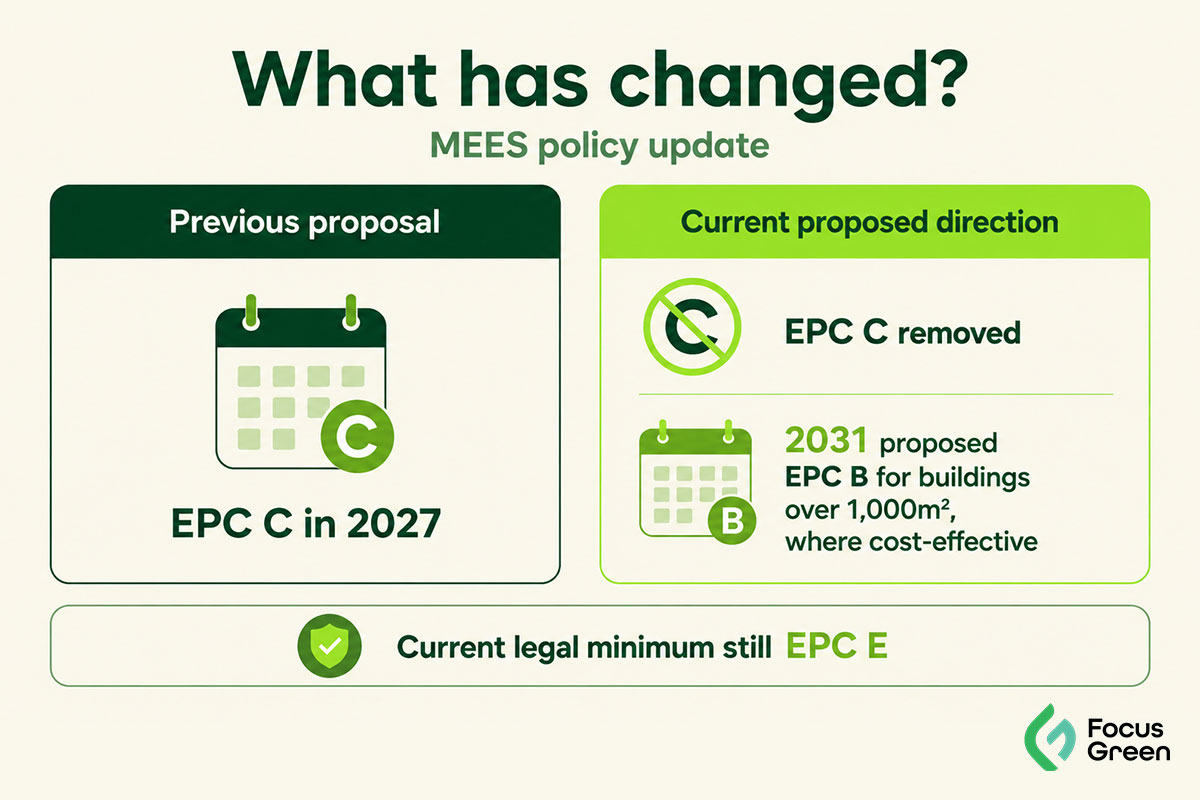
The latest government update changes the future direction of non-domestic MEES. From 2031, the government proposes that non-domestic privately rented buildings over 1,000 square metres in England and Wales will need to reach EPC B, where cost-effective. Buildings below 1,000 square metres are intended to remain subject to the current EPC E minimum where they are within the scope of non-domestic MEES.
The government has also confirmed that the previously proposed EPC C milestone for 2027 will not be taken forward. That gives landlords and tenants more time to plan improvements around real building conditions, lease agreements and investment cycles, rather than rushing towards an interim target.
However, this should not be treated as a pause. EPC B is a much higher standard than EPC E, and larger commercial buildings often require coordinated decisions on lighting, controls, heating, cooling, ventilation, insulation, glazing, plant replacement, and tenant access. Early planning matters because these decisions are rarely quick or simple.
Why this matters for commercial landlords
The biggest mistake would be to read the update as “nothing to do yet”. The EPC B requirement will only take effect after secondary legislation has passed through Parliament, and further details on the 1,000m² threshold are still expected. But landlords can already do useful work: identify likely-affected assets, review current EPCs, and understand possible routes for improvement.
The commercial risk is not only enforcement. A weak MEES position can slow down lease negotiations, complicate due diligence, create budget uncertainty and leave landlords with fewer options when works eventually become necessary. In our experience, MEES is much easier to manage when it is planned alongside normal asset management.
Focus Green’s view is that early review does not mean unnecessary spending. It means knowing which properties are compliant today, which may be exposed later, and where evidence may be needed to support cost-effectiveness or an exemption.
Who is affected?
The proposed EPC B pathway is most relevant to landlords and property teams responsible for larger non-domestic privately rented buildings. Offices, industrial units, logistics assets, retail parks, leisure assets, and multi-let buildings may all need review if they are likely to exceed the proposed 1,000m² threshold.
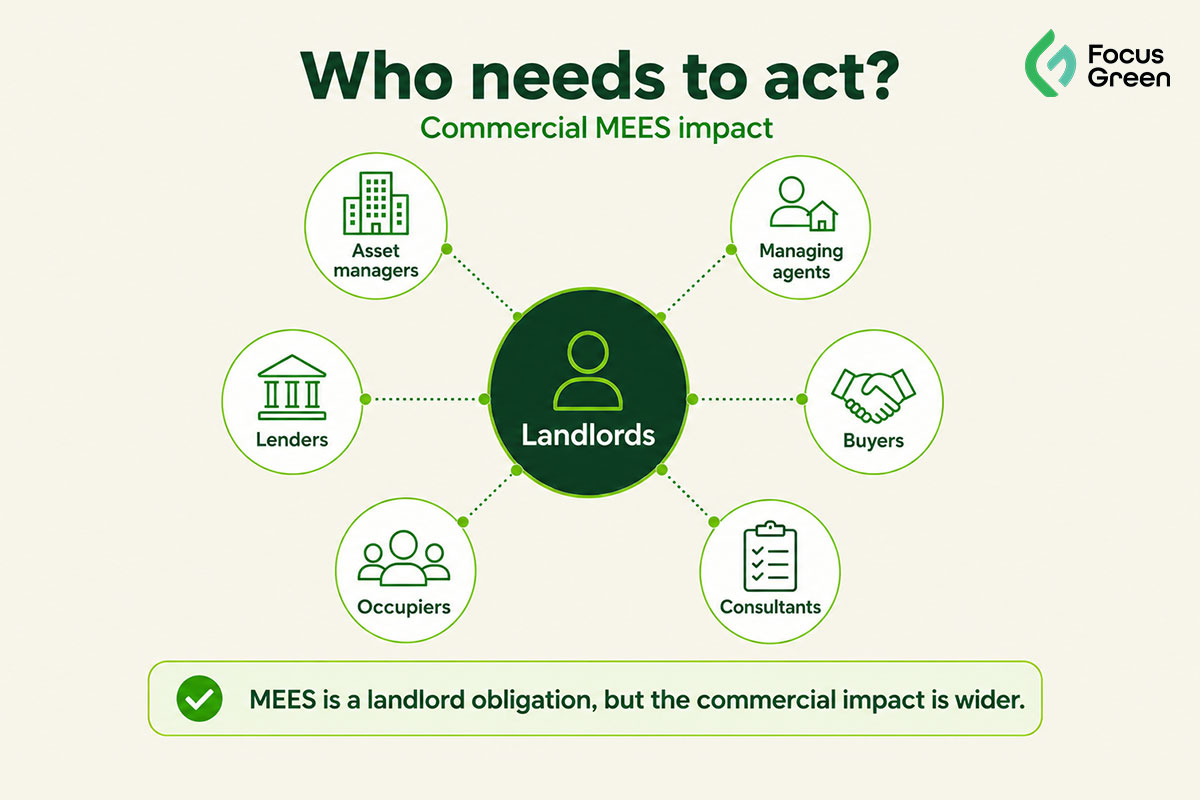
MEES is primarily a landlord obligation, but its commercial impact is wider. Managing agents, asset managers, lenders, purchasers, and occupiers may all be affected as lease events, refinancings, sales, or acquisitions approach. A poor EPC rating can quickly become a wider commercial conversation.
Commercial property teams should review MEES carefully where an asset:
- is let, re-let, renewed or extended
- is rated EPC F or G
- has an EPC close to expiry
- has been altered, split or combined
- may be over 1,000m²
- is part of the sale, refinance or acquisition due diligence
Current non-domestic MEES rules: EPC E still applies today
The live rule should not be overshadowed by the 2031 discussion. Since 1 April 2018, landlords have only been permitted to grant, renew, or extend a tenancy for a qualifying non-domestic rented property if it has at least an EPC rating of E, unless a valid exemption is registered. Since 1 April 2023, the EPC E requirement has applied to all privately rented non-domestic properties within scope, even where there has been no change in tenancy.
That means EPC F and G assets can create an immediate issue. If MEES applies, the landlord may need to improve the property to EPC E or register a valid exemption before the property can lawfully continue to be let. Leaving this until a transaction date can reduce the landlord’s options.
Enforcement is carried out by Local Weights and Measures Authorities. They can serve compliance notices and, where a breach is confirmed, impose penalties. For non-domestic MEES breaches, penalties for unlawfully renting out a non-compliant property are linked to rateable value: less than three months can attract a penalty of up to the greater of £5,000 or 10% of rateable value, capped at £50,000; three months or more can attract a penalty of up to the greater of £10,000 or 20% of rateable value, capped at £150,000. Misleading information or failure to comply with a compliance notice can also lead to financial penalties of up to £5,000 and publication of non-compliance.
Which commercial properties are covered by MEES?
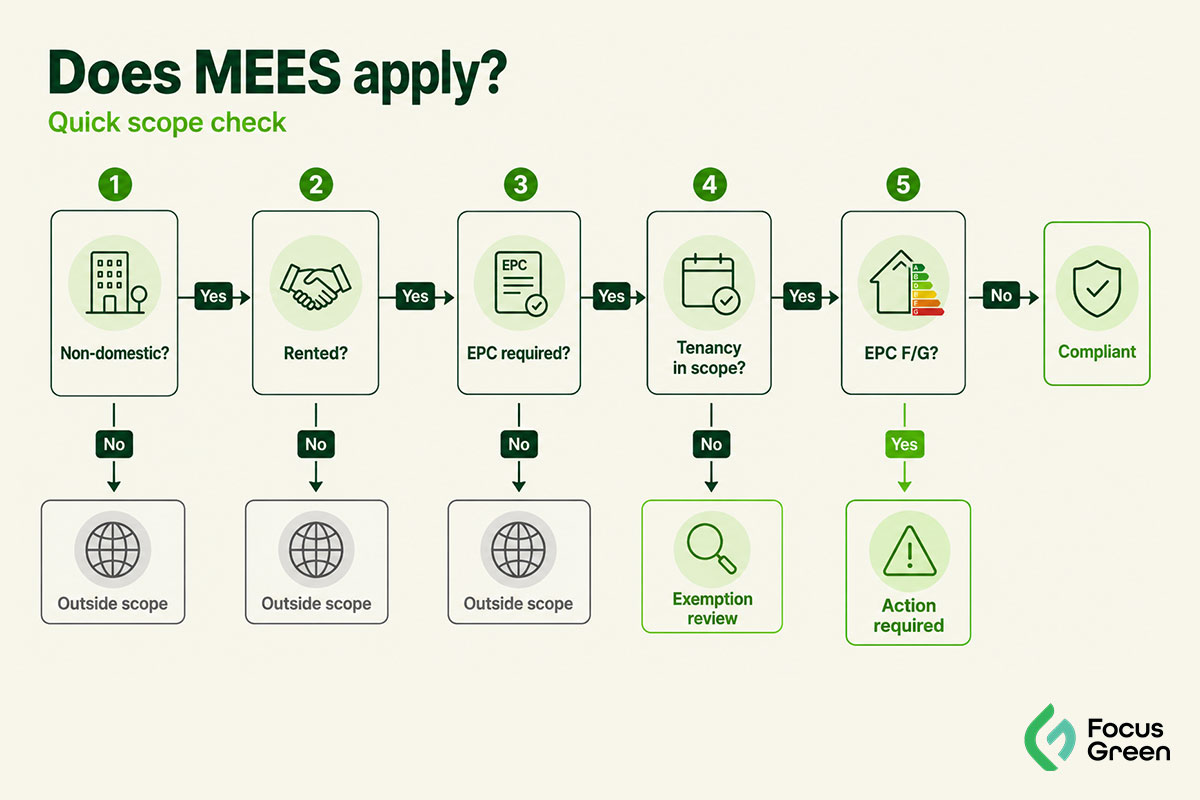
MEES applies to non-domestic rented properties that are legally required to have an EPC. GOV.UK says you must have a commercial EPC if you rent out or sell the premises, when a building under construction is finished, or where changes to the number of parts used for separate occupation involve providing or extending fixed heating, air conditioning or mechanical ventilation systems. All EPCs are valid for 10 years.
There are important exclusions. The regulations do not apply to certain very short tenancies, unless specific renewal or occupation conditions apply, or to tenancies granted for a term certain of 99 years or more. Some buildings may also be exempt from needing an EPC at all, including listed or officially protected buildings where minimum energy performance requirements would unacceptably alter them, temporary buildings only going to be used for two years or less, places of worship, low-energy industrial sites or workshops, detached buildings under 50m², and buildings due to be demolished where the relevant planning and conservation consent conditions are met.
This is why landlords should avoid assuming that the EPC rating alone gives the full answer. The tenancy, EPC requirement, building layout, certificate boundary and current use of the building all matter, especially in multi-let or altered commercial properties.
The proposed EPC B 2031 requirement for buildings over 1,000m²
The proposed 1,000m² threshold is the key change for larger commercial landlords. Rather than moving every rented commercial property towards EPC B, the government intends to focus the future standard on larger non-domestic privately rented buildings, while smaller buildings within scope will remain under EPC E.
For larger assets, the route to EPC B may involve multiple measures rather than a single upgrade. A building currently rated EPC D or C may still need a technical review to determine whether EPC B is achievable, cost-effective, and best delivered through planned works.
This is where portfolio segmentation becomes useful. Smaller properties, current F/G risks and likely 1,000m²-plus assets should not be treated in the same way. Each needs its own compliance pathway, evidence position and timing strategy.
Why the 1,000m² threshold needs careful handling
The government has said further details on the implementation of the threshold will follow. Until final legislation and updated guidance are available, landlords should avoid firm assumptions about complex buildings, multi-let assets, multiple EPCs or inconsistent floor area records.
That uncertainty is exactly why early review matters. Landlords do not need every final detail to begin preparing useful information. Focus Green would typically start by checking EPC ratings, expiry dates, floor area data, lease structures, plant condition, existing recommendations and planned works.
For larger portfolios, this can reveal issues that are not obvious on a spreadsheet. A property may appear low risk until EPC boundaries, demises, historic alterations, or upcoming tenant events are properly reviewed.
Why the removal of EPC C in 2027 matters
The removal of the EPC C 2027 milestone gives landlords more time, but it should not be mistaken for permission to delay. The proposed EPC B pathway for larger buildings from 2031 remains the direction of travel.
The benefit is flexibility. Landlords can now plan works around lease events, refurbishment, plant replacement, tenant fit-out and capital expenditure cycles, rather than rushing into short-term measures that may not support the longer-term EPC B route.
The risk is that some landlords lose that advantage by waiting. A measured review now can help identify whether an asset needs minor improvement, phased investment, technical modelling, or evidence of exemption.
What does “cost-effective” mean?
Cost-effectiveness is central to MEES. GOV.UK guidance says not every property is expected to meet the minimum EPC standard in every circumstance, but landlords should undertake improvements that achieve the highest EPC rating a cost-effective package can deliver.
For non-domestic property, the 7-year payback test is particularly important. A measure, or a package of measures, fails the test if the expected energy bill savings over seven years are less than the cost of purchasing and installing the improvement.
From a Focus Green perspective, this is where evidence matters. Saying that works are “too expensive” is not enough. The position should be supported by EPC evidence, technical review, quotations, calculations and a clear audit trail.
MEES exemptions: when EPC E or EPC B may not be achievable
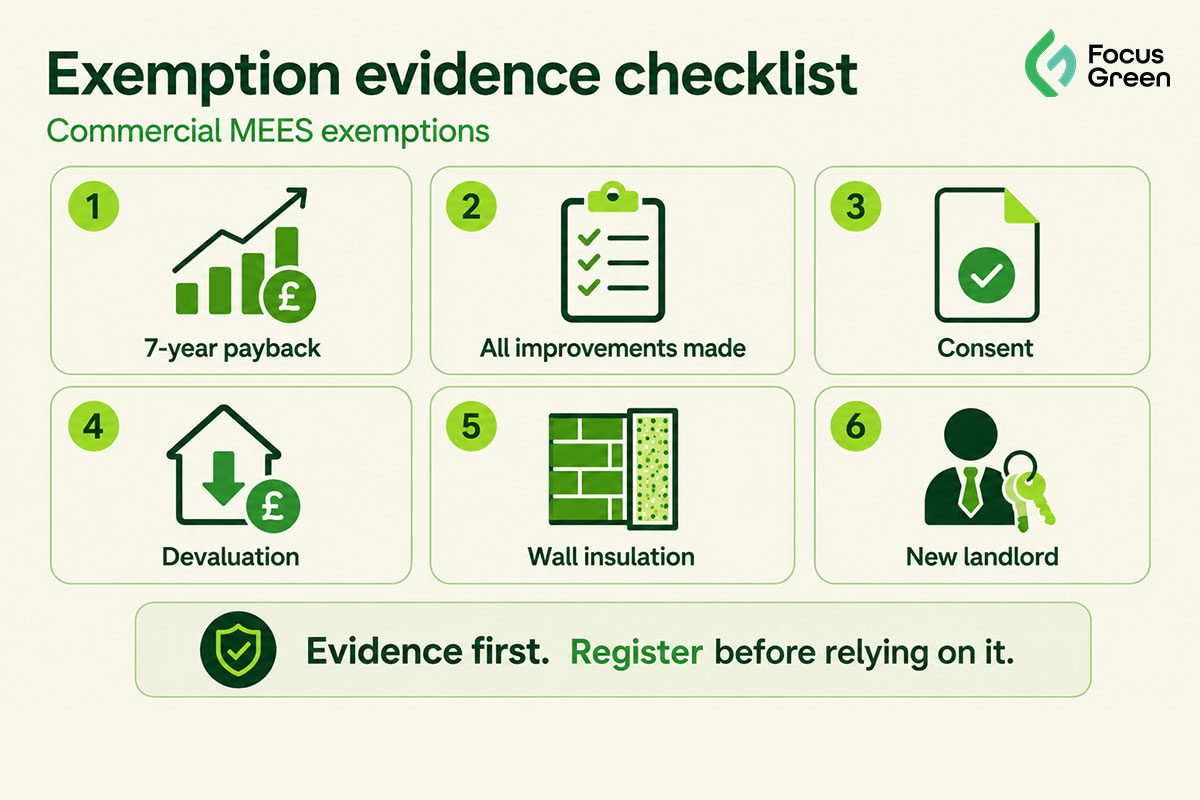
There are situations where a commercial building cannot reasonably meet the required EPC standard, or where works cannot proceed due to cost, technical, consent, or valuation issues. In those cases, MEES allows specific exemptions, provided the criteria are met, and the exemption is properly registered before it is relied on.
Current non-domestic MEES exemptions and exceptions include:
- 7-year payback exemption
- all relevant improvements made / no relevant improvements can be made exception
- wall insulation exemption
- third-party consent exemption
- property devaluation exemption
- temporary new-landlord exemption
An exemption is not automatic and should not be treated as a shortcut. Many exemptions last five years, while the temporary new-landlord exemption lasts six months. Where lack of tenant consent is the issue, the exemption lasts for five years or until the current tenancy ends or is assigned to a new tenant, whichever is sooner. Registered exemptions do not pass to a new owner; if the property is sold or otherwise transferred, the exemption will cease to be effective, so exemptions should be carefully reviewed during acquisition due diligence.
Financial impact: indicative capex bands
The government does not publish universal £/m² capex bands for upgrading commercial buildings to EPC B, and generic figures can be misleading. A small office, a multi-let retail block, a logistics unit, and an older industrial building can all have very different improvement routes. The right starting point is a building-specific review, not guesswork.
For early planning, Focus Green would usually think in terms of capex risk bands rather than fixed national cost figures. A low-intervention asset may need EPC modelling, lighting upgrades, controls or recommissioning. A medium-intervention asset may need refurbishment-linked upgrades to HVAC systems, insulation, glazing, or building management systems. A high-intervention asset may require strategic plant replacement, fabric works, electrical capacity review and phased tenant access.
This is one of the strongest reasons not to wait. Early MEES planning does not require immediate spend; it helps landlords decide whether to budget, phase works, align improvements with existing maintenance plans, or gather evidence to determine whether measures may not be cost-effective.
Market implications
MEES can influence more than legal compliance. EPC ratings are increasingly relevant to lettability, lease negotiation, due diligence, lender questions and occupier expectations. A building that is compliant today may still raise concerns if there is no credible plan for future energy performance.
We would avoid making blanket claims about valuation impact because every asset is different. However, a poor MEES position can create friction. Buyers, lenders and tenants often want clear answers: current rating, future exposure, likely works, responsibility, timing and evidence.
For landlords, this makes MEES a commercial planning issue. A clear, documented MEES strategy can support confidence during transactions and reduce uncertainty in conversations with occupiers, agents and professional advisers.
What should commercial landlords do now?
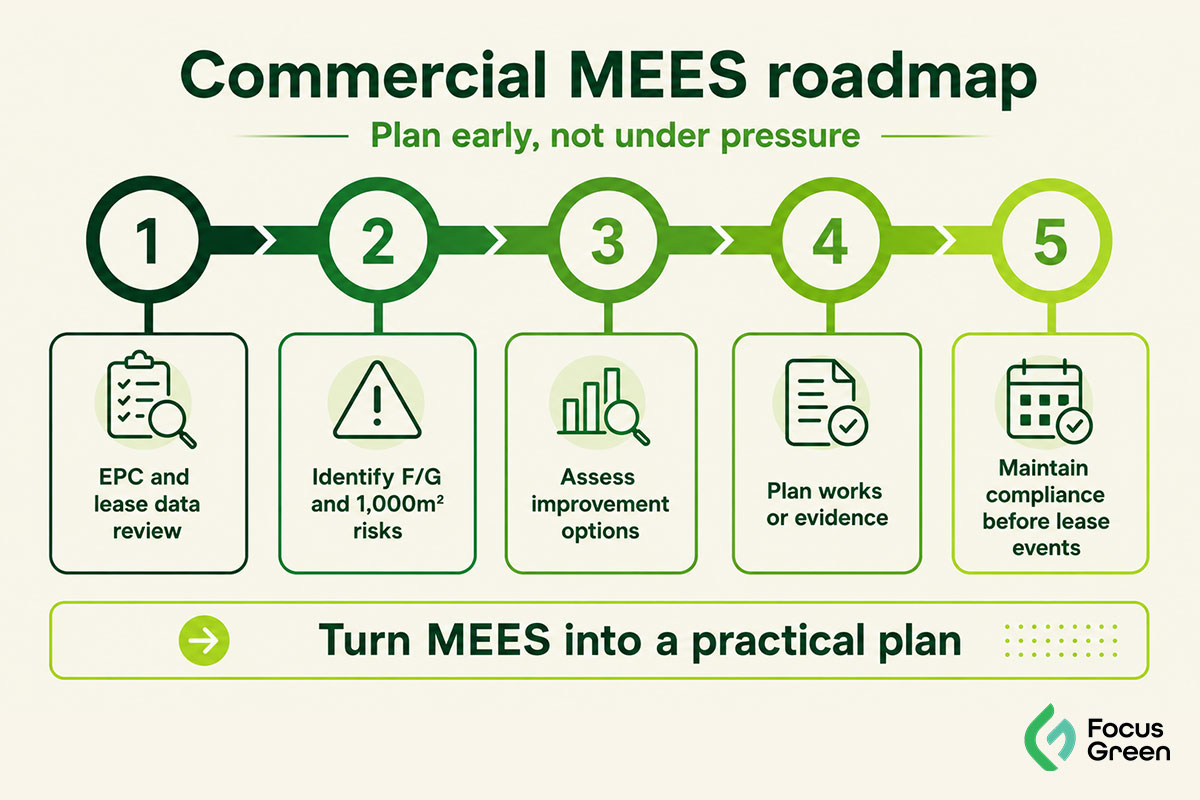
At Focus Green, we recommend a measured, evidence-led approach. Start with a clean portfolio view: EPC ratings, certificate expiry dates, F and G assets, floor areas, lease events, and properties likely to exceed the proposed 1,000m² threshold.
Once the data is clear, move from awareness to planning. A good MEES strategy should connect compliance with maintenance, refurbishment, tenant works, dilapidations and capital expenditure decisions.
A sensible MEES action plan should include:
- reviewing EPC ratings and certificate expiry dates
- identifying EPC F and G risks
- checking assets that may fall above 1,000m²
- reviewing lease events and planned works
- testing whether EPC recommendations are technically suitable
- preparing exemption evidence where appropriate
- creating a prioritised compliance roadmap
The aim is to answer four questions: does MEES apply, what rating is required now, what rating may be required later, and what is the lowest-risk route to compliance?
How Focus Green can help with MEES compliance planning
Focus Green helps commercial landlords, managing agents, asset managers and property teams understand their MEES position with confidence. We translate the regulation into practical action, so clients know which properties need attention, what evidence is required and how to plan improvements sensibly.
Every commercial property is different. A retail unit, office, warehouse, leisure asset or mixed commercial building can raise different EPC and MEES questions. A generic checklist is rarely enough; the value lies in understanding the building, lease position, and wider asset strategy.
We can support commercial clients with:
- commercial EPC reviews and MEES risk checks
- portfolio EPC rating and expiry analysis
- EPC F and G risk identification
- proposed EPC B pathway assessment
- improvement planning aligned with lease and refurbishment cycles
- exemption evidence support
- MEES compliance roadmaps
For larger buildings, we help clients prepare for the proposed EPC B 2031 pathway without overspending or acting on assumptions. For smaller buildings, we help ensure the current EPC E requirement is not overlooked before lease events, sales, or refinancings.
The MEES question every fund manager should be asking:
Is EPC B already law?
Not yet. The government has confirmed its intention to implement EPC B from 2031 for non-domestic privately rented buildings over 1,000m² in England and Wales, where cost-effective, but the change will only take effect after secondary legislation has passed through Parliament.
That distinction matters because landlords should not describe EPC B as a current legal requirement. The current legal minimum remains EPC E for qualifying non-domestic rented property.
However, it is equally important not to use that as a reason to wait. Landlords can already review which assets may be affected, what works may be realistic, and what evidence may be needed.
Does that mean landlords should wait?
No. Waiting may reduce options around procurement, tenant access, lease timing, budget planning and evidence gathering.
Early preparation does not mean unnecessary spending. It means understanding the EPC position, likely exposure, improvement routes and exemption position before decisions become urgent.
From a Focus Green perspective, the best time to review MEES is before a lease event, sale, or refinance, or before a tenant discussion that pressures the timetable.
Do smaller commercial buildings need EPC B?
Under the current proposal, non-domestic privately rented buildings below 1,000m² are intended to remain subject to EPC E where they are within scope, and the EPC C 2027 milestone will not be taken forward.
That does not mean smaller commercial buildings should be ignored. If a qualifying property has an EPC rating of F or G, it may already create a compliance issue under the current rules.
Smaller properties may also need review where an EPC is close to expiry, the building has changed, or a lease, sale, or refinance is approaching.
What if my commercial property has an EPC rating of F or G?
If a qualifying non-domestic rented property has an EPC rating of F or G, the landlord must take appropriate steps to comply with the current EPC E requirement or register a valid exemption where one applies.
The right route depends on the building. Some properties can be improved relatively straightforwardly; others may need technical review, evidence of cost-effectiveness, consent checks, or an exemption assessment.
This should not be left until a tenant or transaction deadline. A proper MEES review can clarify whether the issue is straightforward, cost-sensitive or evidence-led.
How long does a commercial EPC last?
A commercial EPC is valid for 10 years. However, it may not accurately reflect the current building if the layout, activity areas, or fixed building services, such as heating, cooling, ventilation, lighting, or controls, have changed since the certificate was produced.
For MEES planning, reliability matters as much as expiry date. An older EPC may still be valid, but it may not give the landlord the clearest view of current risk.
Before lease events, refurbishment decisions, sale or acquisition, landlords should consider whether the EPC still reflects the building and whether the recommendations remain appropriate.
Speak to Focus Green about your commercial MEES position
The latest MEES update gives landlords more time to plan, but it also confirms the direction of travel. EPC E remains the minimum today for qualifying non-domestic rented property; EPC B from 2031 is the proposed route for larger non-domestic privately rented buildings over 1,000m² in England and Wales, where cost-effective.
The landlords who review their position now will be better placed to control cost, timing, evidence and tenant disruption. Those who wait may find themselves making decisions under pressure, with fewer practical options available.
Speak to Focus Green to review your commercial MEES risk, EPC ratings and compliance roadmap with a specialist consultant.