From April 2026, wholesale water and wastewater charges are changing across England. For many businesses, the practical effect of those changes will only become fully visible when the latest bill is received. In some regions, the increase may be relatively modest. In others, the change is more substantial and may increase annual operating costs, particularly for organisations with higher consumption, complex estates, or multiple commercial sites.
For the 2026 pricing cycle, timing is important. Current wholesale rates apply until 31 March 2026, with new charges taking effect from 1 April 2026. Updated business water bills will then begin appearing from April 2026 onwards. This is the point at which many organisations are likely to see the practical effect of the new charging year reflected in day-to-day costs.
The most important point is that these increases are not uniform. Business water charges are influenced by the regional wholesaler serving each site, meaning location has a direct bearing on how strongly a business may be affected. Two organisations with similar water usage may therefore see very different billing outcomes simply because they sit in different wholesaler areas.
For that reason, this is not simply a pricing update. It is also a prompt for businesses to review the structure and accuracy of their current water account. A wholesale increase may be unavoidable, but the overall cost impact is not always as fixed as it first appears. Higher charges often bring older account issues into sharper focus, including estimated consumption, incorrect wastewater assumptions, unsuitable tariffs, outdated account records, and charging arrangements that may no longer reflect how the site operates.
Why the Wholesaler Region Matters in 2026
Business water billing is not based on a single national rate. Charges are structured around wholesale and retail components, and that distinction matters commercially because the regional wholesaler directly influences a significant part of the total account.
The wholesale element concerns the underlying infrastructure serving each area, including the clean water supply, wastewater treatment, and the physical network that supports delivery. The retail element covers the commercial management of the account, including billing, meter reading, customer support, and account administration. Together, these elements determine how the final bill is constructed and where savings opportunities may still exist.
As a result, the wholesaler connected to a particular site directly affects the charges applied to that account. Even when a business has not changed its usage, operations, or site activity, costs may still change due to regional wholesale changes. This is exactly why businesses should not assume that market conditions are the same everywhere, or that a general comment about rising water prices applies to their own position.
That regional variation is what makes 2026 especially important. The key issue is not simply whether prices are increasing, but how the approved wholesaler changes in a specific region affects the site's overall commercial position. For businesses in harder-hit areas, that creates a stronger case to review the account in detail, challenge avoidable costs, and assess whether better value can be secured through account correction, optimisation, or a more competitive retailer arrangement.
Which Regions Are Seeing the Greatest Increases?
The latest approved figures show that some wholesaler areas are facing materially greater changes than others. That makes regional review particularly important for businesses seeking to understand how their next bill may change.
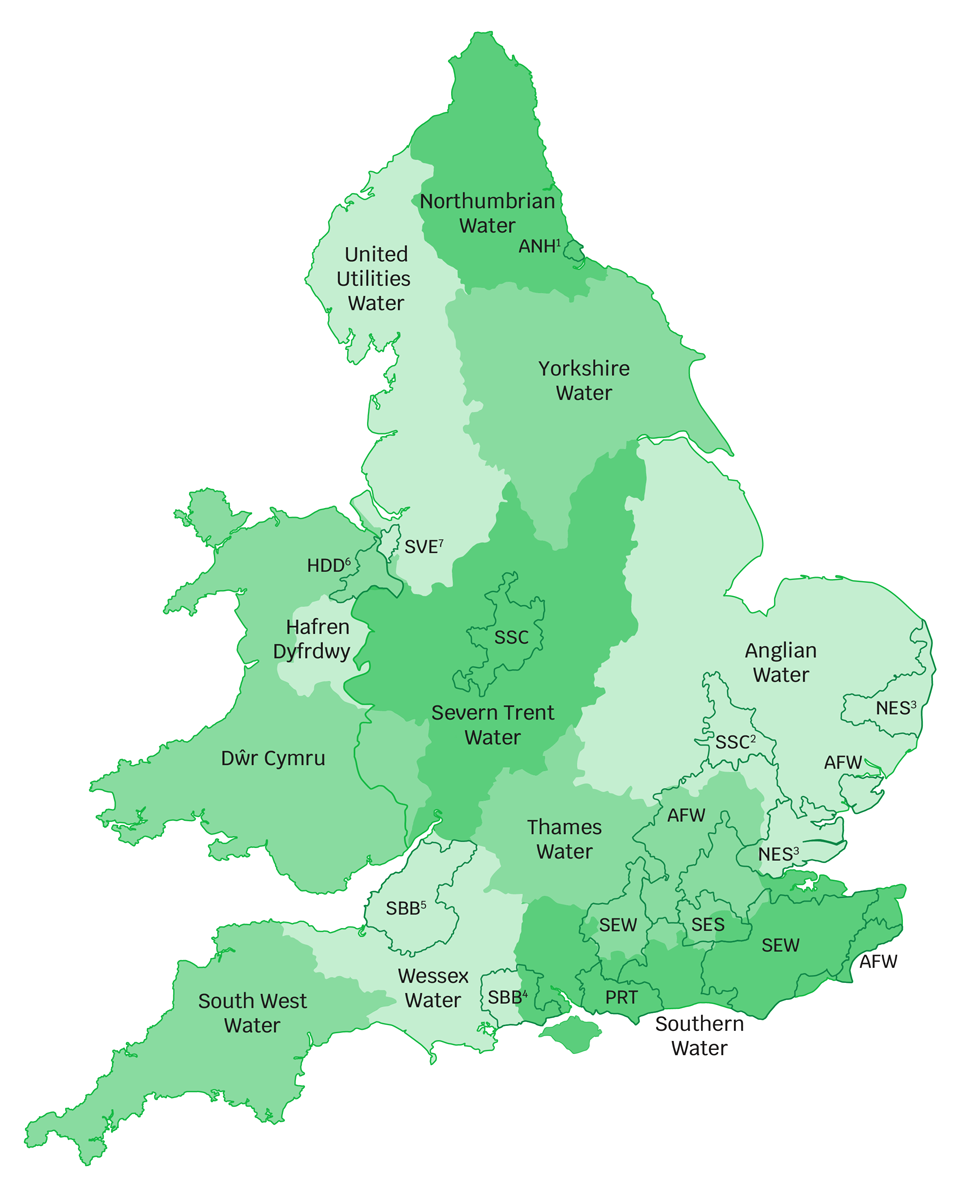
Regional Price Impact Overview
Click a hotspot on the map to view the pricing position for that wholesaler region and where commercial bill review may be most important.
United Utilities
One of the sharpest headline increases in the schedule. Businesses in the North West may wish to review water charges, wastewater treatment, and wider account accuracy more closely.
Review Your Water Costs With Focus Green
If rising wholesale charges are affecting your business, our team can help assess billing accuracy, wastewater assumptions, and whether switching or account review could improve value.
Northumbrian Water
A more moderate increase than some regions, but still relevant for higher-consumption sites or businesses that have not reviewed account assumptions recently.
Review Your Water Costs With Focus Green
If rising wholesale charges are affecting your business, our team can help assess billing accuracy, wastewater assumptions, and whether switching or account review could improve value.
Yorkshire Water
Water charges are relatively modest, but sewerage is more notable. The overall account should therefore be reviewed rather than the water charge in isolation.
Review Your Water Costs With Focus Green
If rising wholesale charges are affecting your business, our team can help assess billing accuracy, wastewater assumptions, and whether switching or account review could improve value.
Anglian Water
A mixed charging position. Even where headline pressure appears lower, commercial customers should still confirm that the wider billing structure remains accurate.
Review Your Water Costs With Focus Green
If rising wholesale charges are affecting your business, our team can help assess billing accuracy, wastewater assumptions, and whether switching or account review could improve value.
Severn Trent Water
The sewerage increase is a more significant feature here, making wastewater and drainage assumptions particularly important to review.
Review Your Water Costs With Focus Green
If rising wholesale charges are affecting your business, our team can help assess billing accuracy, wastewater assumptions, and whether switching or account review could improve value.
Thames Water
A mixed profile where the final bill effect depends heavily on how water and wastewater charges combine across the account.
Review Your Water Costs With Focus Green
If rising wholesale charges are affecting your business, our team can help assess billing accuracy, wastewater assumptions, and whether switching or account review could improve value.
Southern Water
A significant water increase makes this a higher-impact region for many commercial customers, even though sewerage moves in the opposite direction.
Review Your Water Costs With Focus Green
If rising wholesale charges are affecting your business, our team can help assess billing accuracy, wastewater assumptions, and whether switching or account review could improve value.
South West Water
One of the clearest high-pressure regions in the 2026 schedule. The sewerage increase is particularly significant and may justify immediate commercial account review.
Review Your Water Costs With Focus Green
If rising wholesale charges are affecting your business, our team can help assess billing accuracy, wastewater assumptions, and whether switching or account review could improve value.
Affinity Water
A notable water increase in a compact South East area. Commercial customers may wish to review how the broader account is structured alongside the updated charge level.
Review Your Water Costs With Focus Green
If rising wholesale charges are affecting your business, our team can help assess billing accuracy, wastewater assumptions, and whether switching or account review could improve value.
Bristol Water
A stronger water increase than many regions in the schedule. This may justify closer commercial bill review, particularly where consumption is already significant.
Review Your Water Costs With Focus Green
If rising wholesale charges are affecting your business, our team can help assess billing accuracy, wastewater assumptions, and whether switching or account review could improve value.
Portsmouth Water
A relatively modest water increase, but still worth checking in the context of the full account, especially where wastewater and retail arrangements sit elsewhere in the overall charging profile.
Review Your Water Costs With Focus Green
If rising wholesale charges are affecting your business, our team can help assess billing accuracy, wastewater assumptions, and whether switching or account review could improve value.
South East Water
A clear water increase for many commercial sites in the region. Where budgets are tight, this may be enough to justify a structured account review.
Review Your Water Costs With Focus Green
If rising wholesale charges are affecting your business, our team can help assess billing accuracy, wastewater assumptions, and whether switching or account review could improve value.
South Staffs Water
A lower water increase than many neighbouring regions, but still relevant where account assumptions, tariff suitability, or retailer arrangements have not been reviewed recently.
Review Your Water Costs With Focus Green
If rising wholesale charges are affecting your business, our team can help assess billing accuracy, wastewater assumptions, and whether switching or account review could improve value.
Sutton and East Surrey Water
One of the larger water increases in the South East. Businesses in this area may wish to review account detail more closely as part of wider cost control planning.
Review Your Water Costs With Focus Green
If rising wholesale charges are affecting your business, our team can help assess billing accuracy, wastewater assumptions, and whether switching or account review could improve value.
Wessex Water
A mixed position, with water slightly down but sewerage rising. This is another example of why the full commercial account should be reviewed rather than one line item alone.
Review Your Water Costs With Focus Green
If rising wholesale charges are affecting your business, our team can help assess billing accuracy, wastewater assumptions, and whether switching or account review could improve value.
United Utilities
The United Utilities region is among the most significant in this year’s schedule. Water charges are increasing by 20.3%, while sewerage charges are rising by 9.5%. For businesses across Cumbria and the North West, this may lead to a noticeable increase in annual water-related expenditure, particularly where water demand is already high or multiple sites are involved.
Southern Water
Southern Water also warrants close attention. The approved figures show water charges increasing by 19.4%, while sewerage charges are decreasing by 9.0%. This illustrates an important point for commercial customers: the headline position cannot be judged by a single percentage. The overall financial effect depends on the balance of water, wastewater, and standing charges, as well as the specific configuration of the account.
South West Water
South West Water presents one of the clearest examples of why the full account should be reviewed rather than the water charge in isolation. Water charges are increasing by 12.2%, while sewerage charges are rising by 25.1%. For businesses in Avon, Devon, and Cornwall, this places greater emphasis on wastewater and drainage charges, as any inaccuracy in those areas may now have a significantly greater cost effect than in previous years.
Other Regions Still Require Careful Review
Although the highest increases will naturally attract the greatest attention, other regions should not be overlooked. South East Water is increasing by 12.1%, Sutton and East Surrey Water by 16.1%, Bristol Water by 15.8%, and Severn Trent sewerage by 14.0%. Wessex Water shows a 0.7% reduction in water charges, but sewerage is increasing by 10.5%, while Yorkshire Water shows water up by 2.0% and sewerage up by 8.9%. The commercial implication is straightforward: a modest increase in water usage does not necessarily translate into a modest overall change in the bill once wastewater, drainage, standing charges, and existing account assumptions are taken into account.
Why the April 2026 Bill Matters
In practical terms, the arrival of the April bill is likely to be when many businesses first feel the financial impact of these changes. Pricing updates may attract limited attention in advance, but once higher charges appear on a live account, the commercial impact becomes immediate. For many UK organisations, that is the point at which a routine bill becomes a cost-control issue.
That is precisely why the April bill creates a valuable opportunity to act. A higher charge may reflect approved wholesale increases, but it can also expose deeper account issues that have gone unchallenged for too long. Where billing arrangements have remained unchanged for several years, higher wholesale rates can amplify outdated assumptions, incorrect charging structures, and avoidable inefficiencies, turning previously overlooked issues into material cost pressures.
For many businesses, the greatest savings opportunity does not sit in the tariff change itself, but in the account detail behind it. Billing accuracy, wastewater assumptions, surface water drainage charges, tariff suitability, and the competitiveness of the current retailer arrangement all deserve closer scrutiny as costs rise. In that context, the April 2026 bill should not be seen simply as a higher expense, but as a clear trigger to review whether savings can be identified and stronger value secured.
What Businesses Should Review When the Latest Bill Arrives
Meter Readings and Billing Accuracy
The first area to review is whether the bill is based on accurate, up-to-date data. If the account has been running on estimated readings, a meter exchange has not been recorded correctly, or supply point records are incomplete, a wholesale increase may be unnecessarily amplified.
For businesses with multiple supply points, older sites, or inherited accounts, this issue can be particularly relevant. A bill may appear broadly consistent from year to year, while still containing assumptions or data gaps that distort the true charging position. When rates increase, the financial consequence of those inaccuracies increases as well.
Wastewater Assumptions and Drainage Charges
Wastewater charges remain one of the most commercially important areas to review, particularly in regions where sewerage increases are significant. Many business accounts are built on standard assumptions about how much water supplied to the sewer returns to the sewer. In practice, those assumptions do not always reflect actual site conditions.
Water used for irrigation, production processes, evaporation, washdown activities, cooling systems, or other operational purposes may not return to the sewer in the way assumed by the account. Surface water drainage arrangements may also have changed over time without revisiting the charging basis. Where those assumptions are wrong, businesses may be paying higher wastewater charges than necessary, and the effect becomes more pronounced when regional sewerage rates rise.
Tariffs, Standing Charges, and Account Structure
A further issue is whether the current tariff and charge structure still fits the site as it operates today. Commercial premises change over time. Business activity expands or contracts, layouts are altered, drainage arrangements are modified, and consumption patterns shift. Yet the water account itself is not always reviewed with the same frequency.
As a result, businesses can remain in arrangements that no longer reflect operational reality. This may involve an unsuitable tariff, incorrect treatment of the standing charge, or account settings based on historic circumstances rather than current usage. In a year of regional price increases, reviewing this part of the account becomes more commercially worthwhile.
Can Switching Still Help If Wholesale Prices Are Rising?
Yes. Although switching water retailers does not change the regional wholesaler or remove the approved wholesale increase in effect in that area, it can still improve the business's overall commercial outcome. The wholesale element is only one part of the overall account. The retail arrangement, billing structure, account management approach, and the accuracy of charges all influence what a business ultimately pays and how effectively that account is managed.
This is where a commercial review becomes valuable. A more competitive retail arrangement may help secure better overall value through improved pricing, stronger account support, clearer billing, and a structure better suited to the site's or wider estate's needs. When this is combined with a review of billing accuracy, wastewater assumptions, drainage charges, and account setup, businesses may identify opportunities to reduce avoidable costs and improve long-term control over water expenditure.
For that reason, rising wholesale charges should not be seen as a reason to do nothing. In many cases, they are the trigger for a more commercially worthwhile review. If higher regional rates are now feeding into the bill, it becomes even more important to assess whether the current retailer remains competitive and whether account issues are unnecessarily inflating costs. A well-managed switching and review process may not remove the wholesale increase itself, but it can still help businesses reduce overall spend, improve value, and put stronger cost controls in place.
Why a Formal Review Can Help Reduce Water Costs
Many commercial water accounts remain unchanged for years, particularly when billing appears broadly consistent and no obvious concerns have been raised. While that is understandable, it can also mean that outdated assumptions, incorrect charging structures, and avoidable costs persist without challenge.
A formal review provides a clearer commercial assessment of whether the account still accurately reflects the site, whether wastewater and drainage charges remain accurate, and where savings opportunities may exist through improved account structure, stronger retailer arrangements, or the correction of billing issues. In a higher-cost environment, that type of review becomes increasingly valuable, as even relatively small inefficiencies can have a greater financial impact over time.
For organisations with multiple locations, the case for review is stronger still. Different sites may sit within different wholesaler regions and may therefore experience very different pricing outcomes. Reviewing the portfolio site by site can help identify where cost pressure is greatest, where account issues may be inflating spend, and where switching or account optimisation could deliver stronger savings and better overall value.
How Focus Green supports commercial water reviews
Focus Green works with businesses to identify where commercial water costs can be reduced and where greater value can be secured from the current account arrangement. This includes reviewing billing structure, wastewater assumptions, drainage charges, account accuracy, and the competitiveness of the existing water retailer. Where issues are found, the objective is clear: correct unnecessary costs, improve commercial terms, and help the business pay less than it otherwise would.
While approved wholesale price increases are part of the market, that does not mean the total bill cannot be improved. In many cases, savings can still be achieved by correcting billing errors, challenging inaccurate charges, improving account structure, and moving to a more suitable retailer arrangement where that offers better value. The commercial opportunity is often not in removing the wholesale increase itself, but in ensuring the business is not overpaying on top of it.
A Regional Price Rise Should Trigger Action, Not Acceptance
For UK businesses, the 2026 changes are more than a general increase in water costs. They are a clear commercial prompt to review whether the current account remains competitive, accurate, and delivers proper value. When regional wholesale charges rise, the cost of doing nothing also rises, particularly when billing issues, outdated assumptions, or weak retailer arrangements have gone unchallenged.
If the latest bill is materially higher than expected, the right response is not simply to accept it. It is to review the account properly and identify where costs can be reduced. That means understanding which wholesaler region applies to the site, checking how water and wastewater charges have changed, and assessing whether billing data, wastewater assumptions, tariffs, and retailer terms are still working in the business’s favour.
Wholesale prices may be changing, but that does not mean the total bill cannot be improved. With the right review, businesses can often identify avoidable costs, correct inaccurate charges, secure better value, and strengthen control over future expenditure. For organisations facing higher regional increases, this is exactly the point at which a commercial water review can deliver measurable savings rather than allow unnecessary costs to continue into the next billing cycle.
If your business wants to understand whether its current water charges are accurate and commercially appropriate, Focus Green can help review the account and identify potential savings opportunities.
Mike Woolnough leads Focus Green’s Commercial Water Sustainability Review service and works with businesses to assess billing accuracy, wastewater and drainage charges, rebate opportunities, and the suitability of current retailer arrangements.
Contact Mike today to determine whether avoidable costs, incorrect assumptions, or account issues are unnecessarily contributing to your water expenditure.